


Blackjack Surrender Practical Guide to Knowing When to Give Up a Hand
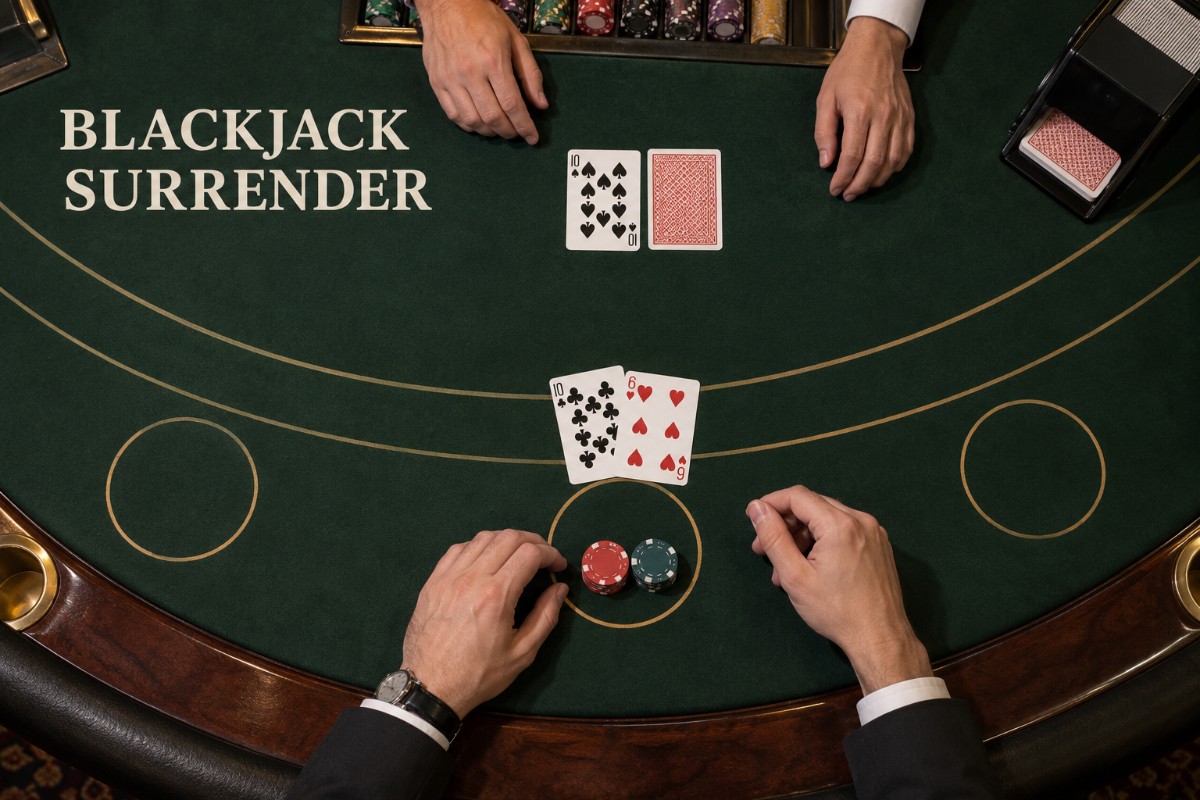
You are dealt 10 and 6 while the dealer shows a 10. The hand is uncomfortable, the dealer appears strong, and taking another card can easily bust you. This is one of the situations where blackjack surrender can matter. Instead of playing the hand to the end, the option lets you give up the hand early and recover part of the original wager when the table allows it.
The idea sounds simple, but the decision is not “quit whenever the hand looks bad”. Surrender is useful only in a small number of mathematically weak situations. A player still needs to know whether the game offers late surrender, how the dealer checks for blackjack, and what the table rules say about eligible hands. Used correctly, it is a damage-control decision rather than a way to turn a poor hand into a winning one.
What surrender actually does to your wager
When the option is accepted, the hand ends immediately and the player normally gives up half stake while the remaining half is returned. If you started with S$20, surrender would usually cost S$10 and return S$10. You no longer draw cards, and the dealer’s later result does not change that settlement.
That trade can be better than continuing a hand with a very poor expected outcome. The important comparison is not between losing half and winning the full amount. It is between losing half now and accepting the long-run result of continuing the hand. Blackjack surrender is therefore about reducing expected loss in selected situations.
Late surrender is the version most players encounter
Late surrender becomes available only after the dealer has checked for blackjack when the visible card requires that check. If the dealer already has a natural blackjack, the original wager normally loses before the player can surrender. If the dealer does not have blackjack, the option may then become available on qualifying hands.
This matters against a dealer 10 or ace because the timing of the dealer check affects whether surrender can be used. A screen that shows the button only after the check is following a different process from a game where the player can surrender before the dealer verifies a natural.
Early surrender is much less common and can be more valuable to the player because it may be allowed before the dealer checks for blackjack. Do not assume the two versions are interchangeable. The table rules should identify which version is offered.
The classic hard 16 decision
A hard 16 is one of the most difficult totals in blackjack because many additional cards will bust the hand, while standing leaves the player vulnerable to a strong dealer total. Against a dealer 10, late surrender is commonly the preferred basic-strategy action when the option is available and the hand composition does not create a separate pair decision.
Consider a 10 and 6 against a dealer 10. If the game permits the option under the relevant rules, giving up half stake can be better over time than repeatedly playing this weak matchup to completion. That does not mean every 16 should be surrendered. The dealer’s visible card and the exact cards in the player’s hand still matter.
A pair of 8s, for example, is normally treated through pair strategy rather than automatically handled as a hard 16. This is why memorising “surrender 16” without context can create new mistakes.
Hard 15 can also create a surrender spot
Another important decision occurs with a hard 15 against a dealer 10. In many common rule sets where late surrender is offered, this can also be a surrender situation. The reasoning is similar: the player’s total is weak, the dealer’s visible card is strong, and continuing the hand can carry a worse long-run expectation than accepting the reduced loss.
Again, table rules matter. Strategy can shift with deck count and other conditions, so the recommendation should come from a chart that matches the game rather than from a generic slogan. A player using single-deck advice at a multi-deck table can easily apply the wrong decision.
Why surrender is not the same as insurance
Surrender ends the player’s hand in exchange for losing part of the wager. Insurance is a separate side wager offered when the dealer shows an ace. The two options solve completely different problems and should not be grouped together simply because both appear before the hand finishes.
With blackjack surrender, the player is choosing to stop playing a weak hand. Insurance asks whether the dealer’s hidden card will complete blackjack. One changes the settlement of the main wager, while the other creates an additional wager.
What happens to side bets when you surrender
This distinction is especially important on tables that offer optional combinations or poker-style side wagers. If you are comparing those additions with normal blackjack decisions, the 21+3 blackjack guide explains how a separate side bet can be evaluated independently from the main hand.
Never assume the half stake calculation applies to every chip placed on the table. Read the side-bet settlement terms separately.
Why the button may not appear on every hand
That is another reason to check the table rules before relying on a planned strategy. If your chart assumes surrender exists but the game does not offer it, you need the next-best action for that hand.
Players who prefer streamed tables can also review the live blackjack guide to understand how real-dealer play, decision timers and table conditions can affect the practical experience of making these choices.
Giving up half can be better than chasing the full wager
Many players resist surrender because losing half stake feels like voluntarily accepting defeat. That reaction is understandable, but blackjack decisions are not judged by whether they feel aggressive or cautious. They are judged by expected value under the rules of the game.
If continuing a particular hand loses more over a large number of repetitions than surrendering it, then preserving half stake is the stronger decision. You will sometimes surrender a hand that would have won if played out. That does not invalidate the choice any more than drawing a recommended card and busting makes the hit automatically wrong.
Rule variations can change the correct play
This is why table rules should be checked before you begin. A printed chart, strategy app or reference should match the conditions of the actual game. If the table uses a rule set different from the one assumed by your chart, some borderline actions can change.
When using Gembet, confirm whether surrender is offered and when it becomes available before relying on it as part of your strategy.
A simple way to handle the decision under pressure
First identify the total correctly. Is it a true hard 16, a hard 15, a pair, or a hand containing an ace that changes how the total should be classified? Next, look at the dealer’s visible card. Then check whether the game offers the option under the current conditions.
If the strategy chart for those table rules says surrender, accept that the goal is to reduce the expected loss rather than rescue the hand. If surrender is unavailable, follow the chart’s alternative hit, stand or split action.
This approach keeps blackjack surrender narrow and disciplined. Blackjack surrender should feel like a rule-based decision, not an escape. It prevents the option from becoming an emotional response whenever a hand feels uncomfortable.
The mistakes that cost more than the surrender itself
One common mistake is ignoring the option because “real players never give up”. Another is surrendering too many hands simply to avoid busting. Both approaches replace strategy with emotion.
A third mistake is treating every dealer 10 as an automatic reason to quit. Strong starting hands should obviously continue, and many weak totals have a different correct action. A fourth is forgetting that a pair can have its own strategy even when its numerical total looks like a surrender candidate.
Finally, never increase the next bet because you surrendered the previous hand. Recovering a reduced loss by risking more money on the next round is still loss chasing.
Where blackjack surrender fits in a stronger approach
Blackjack surrender is a small part of a much larger decision system. Most hands will be resolved through hitting, standing, doubling or splitting. Surrender appears less often, which is exactly why players sometimes overlook it when a useful situation finally arrives.
Remember the purpose: protect part of the wager when the current matchup is poor enough that continuing is mathematically worse. Know how late surrender works, recognise important totals such as hard 16, and verify whether the game allows the option against a dealer 10.
There is no trick that guarantees the next hand will win. The advantage comes from avoiding unnecessary mistakes repeatedly. Used only when the strategy and rules support it, blackjack surrender is one of the clearest examples of accepting a smaller certain loss to avoid a larger expected one.
Experience the real deal with SG's top Live Dealers. Play Baccarat, Roulette & more.

