


Sic Bo Big and Small Practical Guide to Smarter Dice Bets
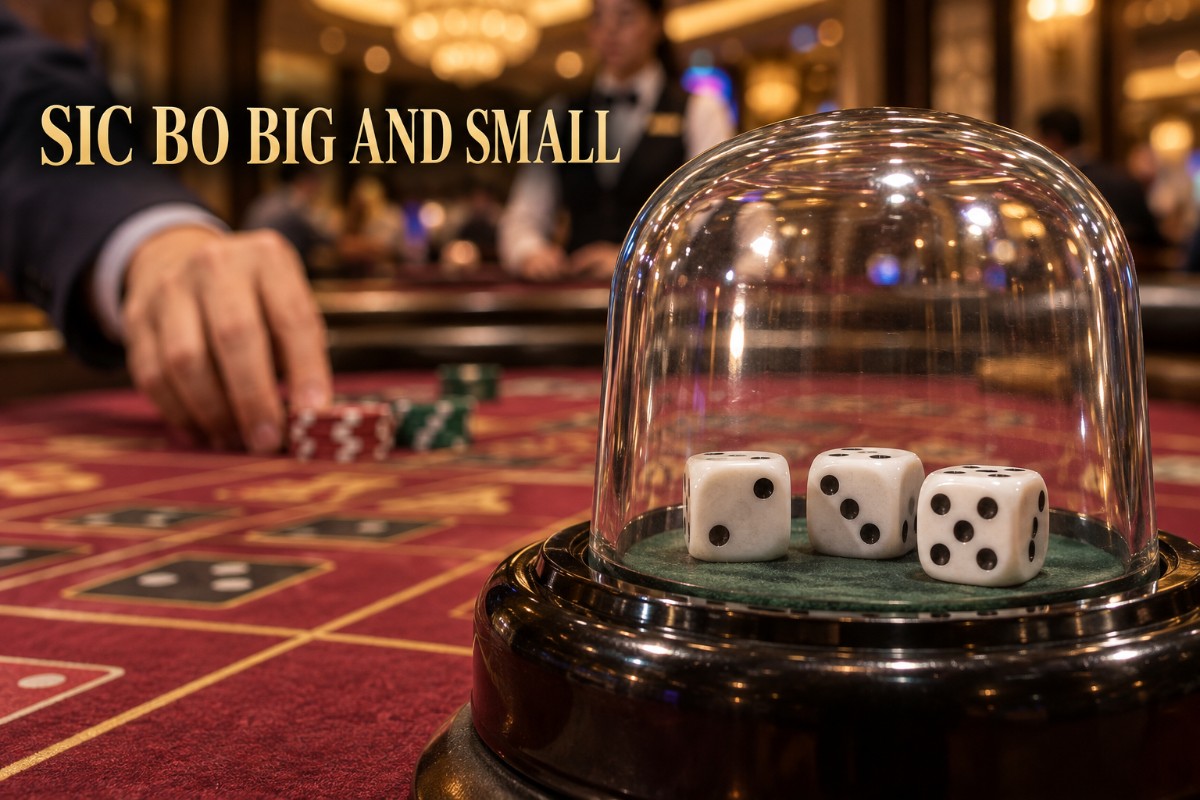
Sic bo big and small is an accessible way to enter a three-dice game because the player is not trying to predict an exact combination. The wager asks whether the total will fall into a lower or higher range, subject to an important exception for triples. That exception stops the bet from being a simple low-versus-high coin flip.
On common standard rules, Small covers totals from 4 to 10 and Big covers totals from 11 to 17. A triple result normally makes both of those wagers lose, even when the arithmetic total falls inside the chosen range. Before placing a chip, the useful habit is to read the betting grid and confirm the exact rule used by that table.
The 30-second version
There are three dice, each showing a value from 1 to 6. Add the faces together after the shake. If the dice total is between 4 and 10, Small is the relevant side. If it is between 11 and 17, Big is the relevant side. Totals of 3 and 18 are necessarily triples, while the other triples also override the ordinary Big or Small classification on common rules.
| Outcome | Standard classification | Big/Small result |
|---|---|---|
| 2 + 3 + 4 = 9 | Small | Small wins |
| 4 + 5 + 6 = 15 | Big | Big wins |
| 2 + 2 + 2 = 6 | Triple | Big and Small lose |
| 5 + 5 + 5 = 15 | Triple | Big and Small lose |
That last column is the detail beginners most often miss. Sic bo big and small is based on both the range and the triple rule, not the arithmetic total alone.
Why the middle ranges are used
With three dice, the possible totals run from 3 to 18. The middle numbers can be formed in many more ways than the extreme numbers. A 10 or 11 has many possible combinations, while 3 can only be made by 1-1-1 and 18 only by 6-6-6.
The standard Big and Small ranges divide the non-triple outcomes around the middle. The wager feels balanced, but the triple exception gives the casino its mathematical advantage when the payout is even money.
The betting grid usually displays Big and Small as large areas because they are simpler than exact-total, double or combination wagers. Large visual areas do not mean one side becomes safer after a streak.
The triple rule is the part worth memorising
Suppose you bet Small and the shaker reveals 2-2-2. The dice total is 6, which normally sits inside the Small range, but the triple result overrides that classification under the common rule. The Small wager loses.
Now suppose you bet Big and the roll is 5-5-5. The total is 15, yet the same exception applies. That triple result also makes Big lose. This is why a player who only remembers “4 to 10 versus 11 to 17” has not learned the complete bet.
Current Evolution rules describe Big as 11 to 17 and Small as 4 to 10, with both losing to any triple. Check the exact game because providers can offer modified variants.
A quick probability check explains the edge
There are 216 equally possible ordered outcomes when three fair six-sided dice are rolled. Under the common rules, 105 outcomes win for Small and 105 win for Big. The remaining outcomes include the opposing range and triples.
If the table pays 1:1, winning on 105 of 216 outcomes gives a house edge of about 2.78%. That does not mean the casino takes 2.78% from every wager. It describes the long-run average built into the price across many rounds.
This is a useful example of why payout and probability should be considered together. Sic bo big and small can look close to fifty-fifty on the layout, but the triple exception prevents it from being a true even-chance proposition. That is the key mathematical feature of sic bo big and small.
Work through the roll before looking at history
Imagine the previous five rounds were all Small. The road display may make that sequence look important, but the next shake is not required to become Big. The previous dice do not remain in the shaker in a way that creates a debt to the other side.
A better process is simpler: identify the wager, know its winning conditions and let the new roll settle independently. The history display can document what happened, but it does not change how the three dice are evaluated in the next round.
The same warning applies after several Big results. Switching to Small only because the opposite outcome feels “due” is not a mathematical strategy. Each new round starts with three dice and a fresh outcome.
Big and Small are not the only choices on the layout
A normal betting grid can also contain Odd/Even, exact totals, single numbers, doubles, specific triples, Any Triple and two-number combinations. Those wagers have different probabilities and payouts.
Predicting a specific triple is much narrower than predicting a broad dice total range, so a larger payout usually accompanies the lower probability. You do not need to cover several alternatives every round.
If your objective is simply to understand a live table before experimenting with extra bet types, the live casino table features guide is a useful companion because it separates interface features from the actual rules that settle a wager.
Covering both sides does not create an advantage
Some players consider placing equal amounts on Big and Small at the same time. On a non-triple roll, one side wins and the other loses, so the two wagers largely cancel when both pay even money. On a triple, however, both can lose under the standard rule.
Covering both sides does not remove the casino advantage. Many ordinary rounds largely cancel while a triple can produce a double loss.
The same principle applies to scattering chips across many parts of the betting grid. More covered areas can create more frequent wins, but total exposure also rises. Win frequency is not the same as profitability.
What changes in multiplier versions
Modern live variants can add random multipliers to selected bet spots after betting closes. Evolution’s Super Sic Bo, for example, can assign enhanced multipliers to selected positions while preserving the underlying idea of predicting the three-dice outcome.
A multiplier changes the payout opportunity on selected spots, but it does not make a particular total more likely. The enhanced payout and the game outcome are separate parts of the design.
If a variant charges an additional fee or changes base payouts for enhanced prizes, include that when comparing it with a classic version. A larger headline multiplier does not by itself prove better value.
Live Sic Bo adds presentation, not prediction
At a live table, betting closes and the dice are shaken before the result appears. Camera angles, road maps and recent outcomes can make the session easier to follow, but they do not forecast the next roll.
If you prefer playing during quieter or busier periods, the site’s live casino peak and off-peak guide can help you think about table availability and presentation separately from the mathematical rules.
Whether the room is busy or quiet, the dice total is still settled according to the current game rules. Live presentation does not change a triple result into an ordinary Big or Small outcome.
A sensible way to approach the bet
Before the first round, decide what you are prepared to spend and choose a stake that fits that budget. Then confirm the Small range, Big range, payout and triple condition.
If you choose sic bo big and small, avoid raising the stake merely because one side has lost repeatedly. A progression changes the amount at risk but does not improve the probability of the next shake. The same is true after a win: increasing the next stake because the table feels favourable is still a larger exposure.
When using Gembet, check the exact help panel before assuming that a familiar-looking table follows the same rules as another version. Small differences in multipliers, fees or payout structures can matter.
What sic bo big and small strategy really is
There is no hidden trick that turns sic bo big and small into a guaranteed-win system. The practical advantage is understanding the wager, avoiding unnecessary high-risk combinations and controlling stake size.
Remember the core sequence: three dice are shaken, the dice total is calculated, and the triple rule is checked before the wager is settled. A triple result can defeat Big or Small even when the numerical total appears to fit the chosen range.
That makes the game easy to follow once the exception is understood. Use the betting grid as a rule map rather than a prediction board, ignore claims that a streak makes the opposite side due, and keep the stake within a planned limit. Those habits will not guarantee a profit, but they make the decision process much clearer and prevent several of the most common mistakes.
Experience the real deal with SG's top Live Dealers. Play Baccarat, Roulette & more.

